

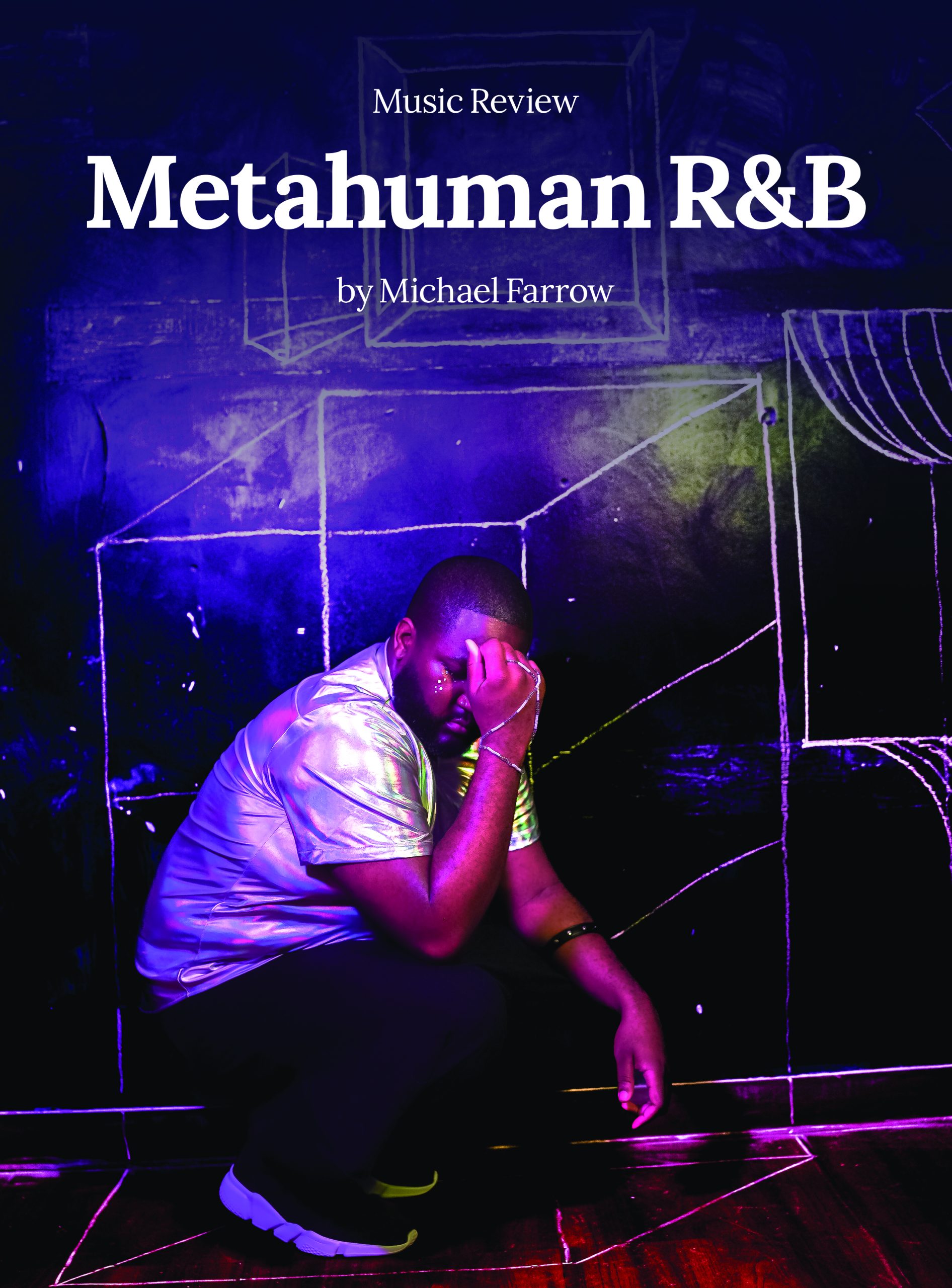
Metahuman R&B
Jay Aquarious, Distortion & Symmetry – 3.8/5
Digital Desire and the Fight for Symmetry
R&B in 2025 was a year of music with no direction. We had J. Bieber making an album for grown-ups, then pulling a Beyoncé and surprising everyone with another album. Instead of Summer Walker leaning into what she does best, she attempts a Whitney/Brandy/Mariah impersonation. But going into the new year, I still haven’t quite gotten over two R&B albums with a clear point of view. They have lingered with me into this year: Miguel’s CAOS and Jay Aquarious’s double EP, Distortion & Symmetry.
Both are R&B performers who wrote songs about love, beauty, and emotion up until 2025. Jay Aquarious, a gay artist from Buffalo, wrote songs mostly about love lost, self-love, and heartbreak. Miguel, whose work has largely centered heterosexual desire, also mostly wrote about having sex and loving beautiful women. He also wrote “Rocket,” performed by Beyoncé — a song so precisely structured around tension and release that one briefly wonders whether Miguel had insider information.
The changes imposed during this second Trump presidency, with its accompanying fear and political instability, shifted both artists. In the same way Marvin Gaye had to ask, “What’s Going On?” Miguel went from singing songs titled “A Sure Thing” and “Adorn” to songs called “The Killing” and “New Martyrs”. With the inclusion of a sonic shift into a violent and political Alt-R&B, and Jay Aquarious moved into political and electronic R&B accordingly.
J Aquarious is asking a dangerous, necessary question: Do we live inside distortion, or do we fight our way toward symmetry?
Distortion & Symmetry is not just a dual album. It’s a mirror held up to see what it means to be human—altered, addicted, learning, and becoming. Across two sides, J Aquarious is transforming in two directions at once: becoming fully human while also becoming something more than human. Metahuman — a cyborg.
From the first moments of “Distortion,” J Aquarious speaks directly, not as a narrator above the story but as someone standing inside the fracture with us. The question isn’t abstract. It’s internal. Not simply “Who am I?” but “Who will we be?”
The Distortion side tracks the painful honesty of becoming human. “Visions” names what many are afraid to say out loud: something is wrong. The distortion is happening all around us. By “Transformation,” the album reaches its pivot point. This is where the fantasy of fixing the world collapses. J Aquarious realizes the revolution is a choice, not a reaction. “Teach Me” is one of the most vulnerable parts of the album.
CHORUS:
NOW, I KNOW
THAT I WAS WRONG
BUT YOU DON’T HAVE
TO COME AT ME STRONG
IF IT LIGHTS UP
THEN THAT’S ON ME
I’D RATHER YOU TEACH ME
(INSTEAD OF JUDGING ME)
It’s radical in today’s culture to admit ignorance. Instead of posturing, Jay clearly asks for education instead of exile. Don’t unfriend me. Don’t disown me. Teach me. In an era built on public shaming, that is a big ask.
“Cry With Beauty” shifts the sonic palette, pulling in Far East Asian influences while interrogating artificial aesthetics. It’s J Aquarious’s “Unpretty”: a reminder that external transformation without internal truth is still distortion. The Distortion side closes with “Addictions,” ending not in resolution but in honesty. No cleanup. No bow. Just truth.
If Distortion is the journey toward full humanity, Symmetry explores the other side of the coin: becoming more than human.
“Stay Alone” opens with independence, a declaration of self-sufficiency that feels almost defiant. But symmetry, it turns out, isn’t isolation. “Caged Bird” reintroduces doubt, belief, and self-interrogation, acting as a bridge between the album’s two worlds.
Then comes “Give It To Me,” a standout track and a clear showcase of J Aquarious’s strength as a lyricist and rapper. It’s confident, sharp, and controlled. The parental advisory placement just before the final stretch feels intentional and clever, a quiet warning that the album is about to get intimate.
“In Too Deep” leans fully into that intimacy. Thick production, sexual storytelling, and the introduction of a robotic voice mark a crucial moment in the album’s metahuman arc. Desire is digital now—no more cruising gay bars or making longing eyes across a crowded room. Now it’s making a good digital impression.
“J. Aquarious is unafraid to ask what we’re becoming, and who gets to decide what counts as who.”
“Past Midnight,” featuring Meagan, is one of the album’s most emotionally effective collaborations. Her voice is given space to breathe, to ache, and to mean something.
The album closes with “Take Me,” a deliberate inversion of “Standalone.” Where the album began with independence, it ends with desire. Not weakness—choice. The arc completes itself.
Sonically, the album commits fully to its futuristic vision. I will not lie and say it was an easy listen. It was tough in some places, but the beeps, boops, electronic textures, and robotic processing aren’t aesthetic gimmicks—they’re narrative tools. The production mirrors the transformation, reinforcing the sense that
humanity and artificiality are unfolding together, not in opposition.
What makes Distortion & Symmetry work is its refusal to choose a single answer. J Aquarious doesn’t argue that becoming more than human saves us, nor that clinging to humanity alone is enough. Instead, the album insists that both transformations are happening simultaneously—and that vulnerability is the only honest response.
Distortion & Symmetry doesn’t resolve the tension it creates. It lives inside it. J Aquarious is unafraid to ask what we’re becoming—and who gets to decide what counts as who.
Rating Scale:
5 – Surpasses the genre — sonically unique, deeply thought-provoking, emotionally powerful, highly original
3 – Good — follows genre conventions, sonically solid, coherent, moderately emotional, and somewhat original
4 – Top of its genre — meets all genre standards, sonically interesting, emotionally resonant, thought-provoking
2 – Lacking — misses some genre elements, sonically weak, less coherent, emotionally flat, and not very original
1 – Fails genre conventions — poor sonically, incoherent, no emotional impact, and lacks originality.
About the Author: MYQ “Mike” Farrow is the charismatic frontman of Buffalo’s genre-blending band Farrow and a creative force in the city’s music scene. A singer, author, and poet-agitator, MYQ F. fuses soulful vocals, folk storytelling, gritty rock, and an Afro-pessimistic style into a sound that is both timeless and forward-looking. Whether crooning a soulful ballad or leading a dancefloor anthem, MYQ F. invites every audience to move, connect, and find joy through Farrow’s acclaimed shows – voted Best Original Music Act by Buffalo Spree (2024).