


Jeff, you fell down the rabbit hole of local LGBTQ history back in 2019? Most people think that Gay Liberation happened in a big city. How did that begin and what has this taught you about LGBTQ history?
It was earlier than that. I was a Women’s Studies minor as an undergraduate because at the time, in the early aughts, that’s the closest I could get to LGBTQ Studies. It was during that time that I “discovered” Leslie Feinberg’s novel Stone Butch Blues at the now closed Main Street location of Talking Leaves Books. This was 2004, and Stone Butch Blues, already a landmark of queer literature, had just been rereleased by Alyson Books, a small Boston-based gay and lesbian press. I bought the book based on the photo of Feinberg on the cover alone. Zie had one of the most arresting faces I’d ever seen: androgynous, handsome, complex, moody, powerful—yet tender. I was equally intrigued by the title whose meaning my then twenty-two-year-old self couldn’t quite discern.
Feinberg’s semi-autobiographical novel tells the story of Jess Goldberg, a working-class butch who, like Feinberg hirself, comes of age in the gay bars and factories of a deindustrializing Buffalo. Many readers feel an affinity with the novel for Feinberg’s nuanced portrayal of a trans character at a time when there were few published works of transgender fiction. While Stone Butch Blues certainly expanded my conception of sexuality and gender, I felt seen by Feinberg’s representations of queer life in Buffalo from the 1950s through the 1980s, an aspect of the novel often glossed over in both scholarly and popular discourse. Until Stone Butch Blues, I didn’t know Buffalo had a queer history.
Then at some point I encountered the name “Madeline Davis” and read Boots of Leather, Slippers of Gold, an oral history of Buffalo’s working-class lesbian community from the 1930s through the mid-1960s that Davis co-authored with Liz Kennedy. Boots and Stone Butch Blues cover a similar period of Buffalo queer history, and I see them as companion volumes to each other. That led me to the Davis Collection at SUNY Buffalo State. I eventually met Madeline herself, and she encouraged my work to document LGBTQ historic places in Buffalo. Carol Speser also became a trusted mentor and friend who has shaped my understanding of the history of LGBTQ advocacy and community organizing.
Next, I did an additional Masters degree in Historic Preservation Planning and LGBT Studies with an emphasis on LGBTQ heritage conservation at Cornell University. As part of my studies, I worked in depth with Cornell’s Human Sexuality Collection and was mentored by the NYC LGBT Historic Sites project, whose co-founders were the driving force behind the historic designation of Stonewall. Now I’m working to document LGBTQ heritage across New York State, not just Buffalo. All this is to say that LGBTQ history exists everywhere, but we’ve tended to focus on major cities whose queer communities had greater visibility, resources, and access to national media than their counterparts who lived outside urban areas. I call such places “queer geographic blindspots” in that they have an LGBTQ history but it hasn’t been incorporated into the “mainstream” historical narratives we tell about LGBTQ people and communities. My work seeks to change that and to move us toward a more geographically holistic understanding of LGBTQ history. This is part of why young people need a comic book about Leslie Feinberg set in Buffalo.
A comic book is such an interesting format in which to tell a story of Leslie Feinberg. How did you and your collaborators come together on this project?
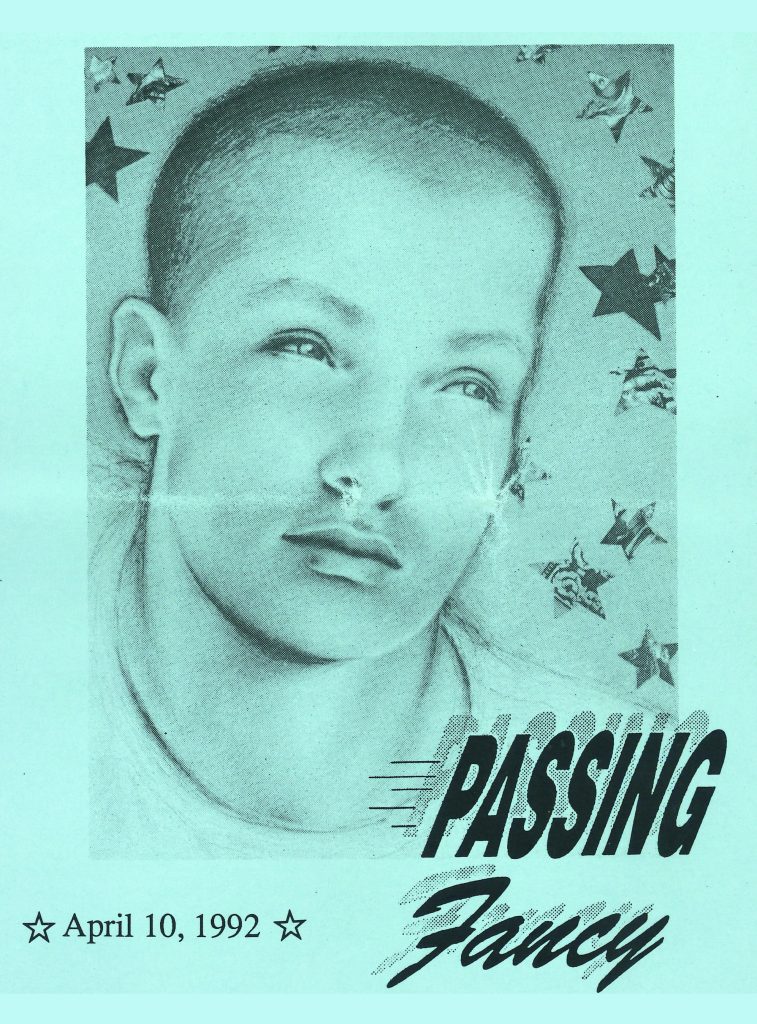
I’m a fan of the comics genre, but never thought I’d work on a comic book, let alone one about Leslie Feinberg. The project sort of fell into my lap. While I was at Cornell I met fellow historian Hugh Ryan, author of When Brooklyn Was Queer and a queer history of the Women’s House of Detention in Greenwich Village, among other accolades. At the time, I was working on a digital project where I used Geographic Information Systems (GIS) to map out places in Buffalo that appeared in Stone Butch Blues. Hugh had a relationship with the New York City Department of Education Civics for All Comics Group and proposed a Feinberg comic to them. Hugh suggested they bring me on board because, by that point, I’d done a tremendous amount of research on Leslie. In addition to the GIS project, I also “instigated” a local historic landmark designation for the office of Firebrand Books, the Ithaca-based feminist and lesbian press that originally published Stone Butch Blues in 1993. The idea behind the comic was to use Leslie’s life and work to teach students how terminology for gender and sexuality changed across time and cultures. I was adamant that the comic be set in Buffalo. I proposed the story be set around an event I’d learned about in the Davis Collection: a 1992 drag king show called Passing Fancy that took place at M.C. Compton’s as a benefit for ACT UP Western New York. Leslie was the MC of the show and also gave a slide presentation on hir research into transgender history that became part of hir second book, Transgender Warriors. Hugh is a fabulous writer, and he came up with the script based on my research. We also worked with trans illustrator Val Halvorson, and Chris Curmi from the Department of Education was our editor. Many of the illustrations Val created are based on archival materials from the Davis Collection or the Buffalo History Museum. At the time, Compton’s was technically called Images, but Sherrill Cooper, the owner, told me everyone always thought of the bar as Compton’s despite her experimenting with different names over the years, so in the comic the bar is M.C. Compton’s. I’m also thankful to Margaret Smith and Tee Fregoe who provided me with additional information about the event. Tee even drew us a floorplan of Compton’s for Val to use. I love the fact that students in New York City and beyond are reading a story about Leslie Feinberg that’s set in Buffalo and brings a largely unknown piece of queer Buffalo history to a broader audience.
“I felt seen by Feinberg’s representations of queer life in Buffalo”
Leslie Feinberg is an icon of the Lesbian and Trans community especially in Western New York. Why did you choose them and why focus on this particular event?
As a historian, I don’t find the concept of icons particularly accurate or useful. I think the status of “icon” flattens and obscures someone’s complex humanity by placing them on a pedestal, thereby limiting the lens through which we view them. In addition, positioning someone as an “icon” often ignores the fact that they existed in a broader social and historical context and as a member of a community. We’ve seen this happen with other LGBTQ historical figures such as Sylvia Rivera, Marsha P. Johnson, and even Madeline Davis. I’m much more interested in understanding someone as a full, complicated, messy person. Do I think Leslie Feinberg and Madeline Davis did historically significant things? Absolutely. That’s undeniable. But neither was superhuman. We can draw from their legacies and carry on the work of equity and justice ourselves. That’s what I try to do.
Yet, I won’t deny the need for icons, especially in the LGBTQ community. When community historians began documenting what was known in the 1970s as lesbian and gay history, they were looking to queer role models from the past because doing so was psychologically beneficial (it still is in many ways). It showed that queer people have always existed in one form or another and gave people sources of inspiration and strength in the present. And it’s especially important for young LGBTQ people to have role models to show them what’s possible for their lives. I think we can both look to the past for inspiration and to shape a better present while also representing that past accurately and fully.
As for the choice of Leslie and Passing Fancy, as a native Buffalonian, if I’m doing anything trans history or LGBTQ print culture-related I’m going to talk about Leslie Feinberg. I’m always mindful of whose shoulders I stand on. Passing Fancy represents a moment in Leslie’s life and career when zie was working out groundbreaking ideas about trans history and oppression, where we see hir grappling with what it means to be “different” and how to use that difference in the service of creating the world one wants to see. Passing Fancy also troubles the narrative that Leslie fled Buffalo never to return because it was a terrible place for LGBTQ people. We often associate Leslie with New York City (technically zie lived in Jersey City for the majority of hir time downstate), but zie would often return to Buffalo and also lived in Syracuse at the end of hir life. There’s a larger Upstate New York Story to be told about Leslie and hir longtime partner Minnie Bruce Pratt.
Do you think young people have any knowledge of Feinberg, was this one of the concerns in using a comic book format?
Young people don’t know enough about LGBTQ history in general because it’s kept from them and often not an official part of the history curriculum in schools. LGBTQ history is often regarded as something “extra,” “unnecessary,” or “inappropriate.” But, as one of my queer history mentors Ken Lustbader always says, “LGBTQ history is American history.” It’s a fundamental part of the story. To deny that is to present a version of history that’s distorted, inaccurate. I also think people in general don’t know enough about Leslie Feinberg and that the stories we tell about hir deserve more nuance and complexity. For example, as I noted above, there’s more to be said about the places Leslie lived and their influence on hir. Zie could also be stubborn, difficult, and dogmatic to the point that it sometimes hindered hir work and vision of justice. Everyone has triumphs and shortcomings, and it’s useful to understand that. It’s important to humanize Leslie so we can better carry on hir legacy.
As for the comic format, I think it’s wonderful the NYC Department of Education has a Civic Comics initiative that includes LGBTQ “icons.” The comics are available online with supporting curriculum—that anyone can use—and I hope they become more widely known. It’s important for young people to know that gender and sexuality are social and historical concepts that change across time and cultures and that people who are gender “different” have a long history and didn’t suddenly emerge within the past five-to-ten years. The visual format of a comic book helps young people better visualize this, and it makes the trans community, past and present, more relatable. Leslie Feinberg is one of the best historical figures to illustrate these concepts.
If we handed you a microphone and you were able to talk to the entire LGBTQ+ community about their history, about Leslie, about how your work in queer history has had an effect on you, what would you say?
First and foremost, I would share that microphone with others who have different identities or experiences than me. LGBTQ history belongs to the community, not to any one individual, organization, or group. I’d share something that Leslie Feinberg said: “I believe that people who have been stripped of their history have lost a valuable tool in determining which road leads forward to liberation.” And I’d share something Madeline Davis once said to me, which is, “I love being gay [she was using this term expansively]. I loved being gay when I came out in the 1960s; I love being gay today. Being gay means being a part of something bigger than yourself to create change.” Finally, I’d say that so much of LGBTQ history, representation, and media focuses on oppression, struggle, and discrimination. Being queer is much more than that. Our story is equally about joy, innovation, creativity, and change-making. Joy comes from finding the thing that makes you feel most alive, how you can make the biggest difference, and doing it to the best of your ability. Find joy. Share joy with others. Know your history. Persist.
Editor’s Note: ICONS #1, In Our Own Voices: Leslie Feinberg was published in Spring 2025 by the Civics for All Comics Group—an imprint that began in early 2020 as a collaboration between the New York City Public Schools and various comics creators to publish non-fiction graphic texts for educational use. In addition to publishing comics, the Civics for All Comics Group regularly presents at conferences and freely shares its resources to educators and schools throughout the country. You can access ICONS #1 for free digitally on WeTeachNYC HERE or access all of the Civics for All Comics Group’s educational comics HERE.
Jeff Iovannone is a social Historian from upstate New York who specializes in conserving LGBTQ+ history through the built environment. He holds a PhD in American Studies from the University of Buffalo, and a master’s in historicpreservation planning and LGBTQ Studies from Cornell University. He has Authored several National Register of Historic Places nominations for LGBTQ historic sites and is the creator of the Digital Exhibit Leslie Feinberg’s Buffalo: Historic Sites in Stone Butch Blues.